
How Arrest Warrants Work in Lawrence County
Arkansas Code §16-81-104 and official judiciary material set the local foundation. A circuit judge, a district judge, or a magistrate may issue an arrest warrant once the required showing is made from personal knowledge or sworn information. The document identifies or describes the alleged offense, then commands an authorized officer to arrest the person and bring that person before a judge or magistrate. Where the record sits depends on the court. Circuit matters route through the Arkansas Circuit Court, Third Judicial Circuit. District matters route through Lawrence County District Court, 11th Judicial District. Municipal police can execute process too. A city officer's paperwork and the clerk's docket can update at different times, and an agency record never replaces the court file. Probable cause is the legal basis for every Lawrence County arrest warrant.
Who Issues Lawrence Arrest Warrants
The Third Judicial Circuit administrative plan adds useful detail. It recognizes district-judge referrals for arrest warrants under Rule 7.1 and A.C.A. §16-81-104. Search warrants under Rule 13.1 appear too. Reasonable-cause findings, first appearances, and release inquiries are covered as well. Circuit and district courts in Lawrence County remain distinct, though Arkansas rules can let a district judge handle specified circuit work.
- Probable cause
- The legal showing required for an arrest warrant, based on sworn information or personal knowledge.
- Magistrate
- A judicial officer authorized by law to perform stated warrant and early-case functions.
- Execution
- The act of carrying out the arrest command.
- First appearance
- An early proceeding where the court addresses the case, rights, and release issues as authorized.
In Lawrence County, the signed order itself is the arrest-warrant record that counts, not the title of any online list.
Arrest Warrants: What They Contain
Arkansas's official warrant and surety form offers a privacy-safe field model. It is not a filled Lawrence County sample, and sealing or access rules can leave a public record with fewer fields. Court and sheriff systems also rely on different identifiers.
| Court caption | County, court, and division tied to the order. |
|---|---|
| Case number | The court identifier used in clerk and Search ARCourts contacts. |
| Named subject | The person identified or described by the process. |
| Offense | The alleged charge or statutory description. |
| Order basis | The finding and warrant language entered by the judge. |
| Bond or surety | Prior bond or surety information when it applies, not a promise of release. |
| Signature and date | The judicial approval and order date. |
| Service status | A later return or agency status when maintained and public. |
A booking number is not the court case number. Use the court case number when you call the Lawrence County clerk.
Lawrence Arrest Warrant Service Answers
Warrant service is a sheriff responsibility in Lawrence County. The official sheriff warrant page tells anyone who believes an active warrant exists to call 870-886-2922. That line handles execution-side questions. Ask whether the sheriff record still shows the warrant, which court appears to own it, and where to get formal instructions. The sheriff office sits at 501 W. Elm St. in Walnut Ridge, and its main number is 870-886-2525. No Lawrence County office posts universal arrest-warrant surrender hours, a bond window, or one release schedule. So call before you go. Confirm where to report, what identification to bring, whether the intake point is the detention center or another office, and when a judicial release decision can occur.
Key distinction: The sheriff answers service and custody questions; the issuing clerk answers court-file, docket, filing, and order questions.
How Warrants Get Served in Lawrence County
An authorized officer executes each Lawrence County warrant. That can be a sheriff's deputy, a municipal officer, a state officer, or other law enforcement acting within lawful authority. Service carries out the judge's command. It may lead to booking, a first appearance, and a release inquiry. No fixed place, time, or bond result fits every Lawrence County arrest warrant. Details come from the responsible agencies. Municipal police and the sheriff are separate agencies. A city officer may make an arrest or refer a city ordinance or misdemeanor matter. The sheriff runs detention and serves county process. Never assume a city contact cleared the order. In Lawrence County, the district or circuit court record, the sheriff's status entry, and the city agency record serve different roles and update on different schedules. Note: Never approach a courthouse, jail, or officer on a web card alone; obtain current reporting instructions first.
ACIC Is Not a Public Warrant Search
The Arkansas Crime Information Center keeps ACIC and NCIC wanted-person files closed to the public. Only authorized criminal-justice users may query them. An Arkansas Freedom of Information Act request cannot open them, because A.C.A. §12-12-211 bars release. So Lawrence County has no official open statewide active-arrest-warrant database for public use. Search ARCourts shows public case information instead: filings, future events, judgments, and some documents, subject to court coverage and Administrative Order 19. It is not a live statewide warrant certification. ARCH is the wrong tool as well. That $24 criminal-history search expressly excludes active warrants. Also excluded are unresolved misdemeanor arrests, traffic citation and arrest history, juvenile records, and sealed records. Work within those boundaries. A sound Lawrence County check combines the sheriff lead, a call to the warrant line, the public court search, and direct clerk confirmation.
Arrest Warrants, Summonses, and Bench Warrants
Each tool calls for a different response. A summons tells you to appear. It does not command an arrest first. A bench warrant usually follows a missed court duty like a failure to appear, while an arrest warrant commands custody after the required legal showing. Arkansas's official form includes warrant, summons, and surety-order paths, keeping those distinctions visible in Lawrence County's court process.
| Feature | Arrest Warrant | Summons | Bench Warrant |
|---|---|---|---|
| Main command | Arrest and bring before a judge | Appear as directed | Arrest after a court-related failure |
| Usual basis | Probable cause tied to an alleged offense | Process allowing appearance without custody | Missed appearance, payment, or other court term |
| Best first call | Sheriff and issuing clerk | Clerk named on the summons | Issuing clerk, then sheriff if needed |
| Proof to retain | Release or disposition order | Appearance and filing record | Recall, quash, or satisfaction order |
For a missed-setting order, see the Lawrence County bench warrant lookup.
When Lawrence Records Conflict
Lawrence County records rarely move in sync. The sheriff's public list runs across several pages with no text search, and its disclaimer warns that entries may lag behind current status. Search ARCourts covers court records only. Court and law-enforcement systems update on separate schedules, so one channel can show a record that another does not.
- Save the case number, court name, and the time each source was checked.
- Call 870-886-2922 for the sheriff’s execution-side status.
- Call the named clerk for the controlling court order and docket status.
- Ask whether the warrant was served, recalled, quashed, satisfied, or remains active.
- Request written proof and ask whether a separate sheriff update is pending.
Never treat a blank result as clearance. The issuing court's current order, plus direct agency confirmation, outweighs any stale Lawrence County display.
Handling an Arrest Warrant in Your Name
Confirm the warrant is current first. Identify the issuing court, too. Then weigh your options with a lawyer. Counsel can size up your exposure, plan an appearance, move the court to recall or quash the warrant, and sometimes reach the Lawrence County court before you surrender. No single filing is guaranteed to recall a warrant, though.
- Call the sheriff warrant line and the issuing clerk before traveling.
- Ask what appearance, surrender, or filing route the court authorizes.
- Confirm the reporting place, hours, identification, first-appearance timing, and release process.
- Ask what bond or release terms have actually been set, if any.
- Keep the court order, receipt, release papers, and confirmation details.
- Recheck both court and sheriff records after the case event.
Important: Arrange legal advice and current reporting instructions before a voluntary surrender; Lawrence County publishes no one-size-fits-all intake or release schedule.
Lawrence County Arrest Warrant Access
Use every channel, not just one. Treat the warrant page as a lead, never a full list. Start with the Lawrence County Sheriff's Office official warrant page. Entries may show name, booking number, booking date, and bond where set. Its vendor cards and disclaimer do not certify live status, so the official page itself marks where its warrant records stop.
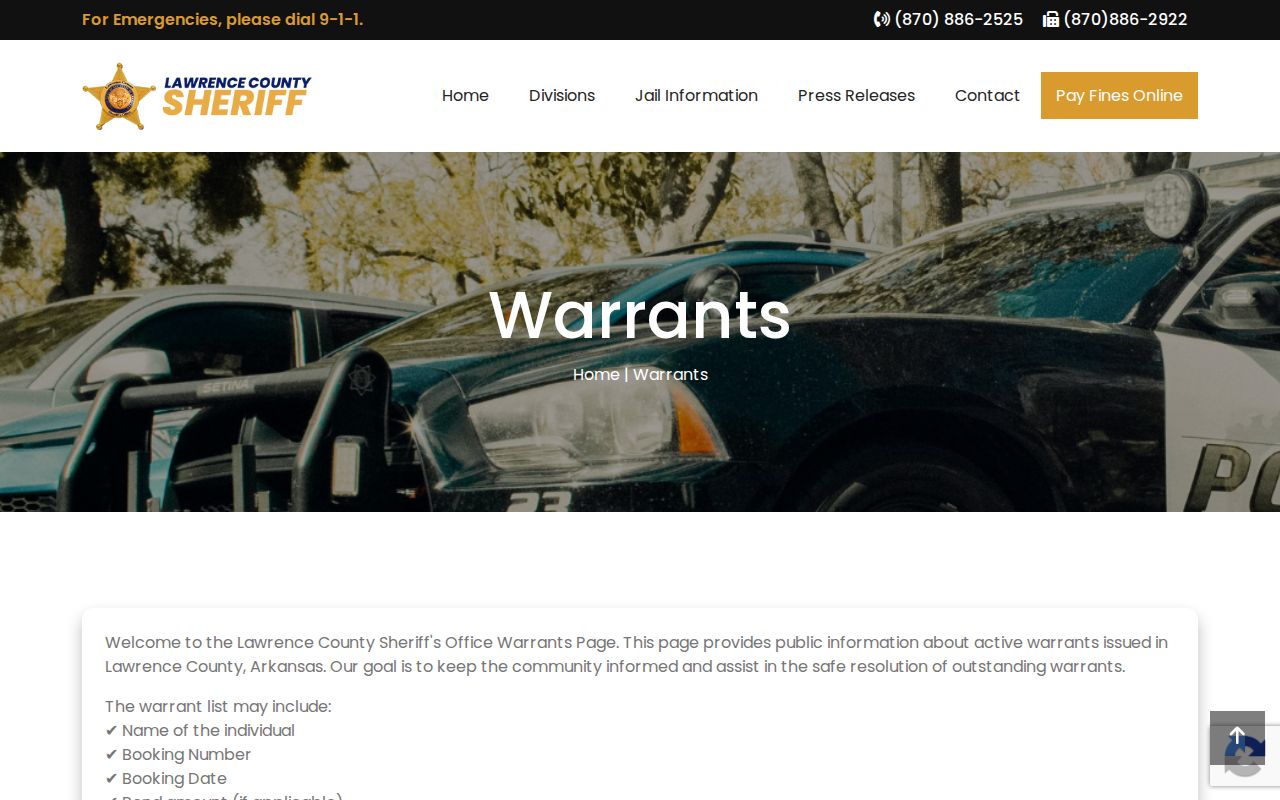
The warrant page itself says to call 870-886-2922. That number is a reminder the web display is only one part of a Lawrence County warrant check. District matters go to Chief District Court Clerk Jamie Hill, 111 W. Main, Walnut Ridge, 870-886-1140. Weekday hours there run 8:00 a.m. to 4:30 p.m. Circuit criminal files belong to Circuit Clerk Michelle Evans at 315 W. Main, Walnut Ridge, 870-886-1112. Arkansas FOIA reaches nonrestricted agency records, procedures, and narrow public requests, by whatever methods state law allows. Administrative Order 19 governs court access. Some matters stay closed. Juvenile, sealed, and confidential records may be withheld or not acknowledged at all. A city ordinance or police matter may take the city office plus District Court. No top-five Lawrence County city runs a separate public warrant-search interface. Call the clerk before assuming anything is settled.